One store fixed 72% of its price exceptions in four days
ShelfOptix scanned one store of a Southeastern U.S. grocery chain on October 12, 2026, and the robot found 646 price exceptions. Store personnel and ShelfOptix labor worked through the list. A rescan on October 16, 2026, with the same robot and the same method, found 182. That is 464 fewer, a drop of 71.8%.
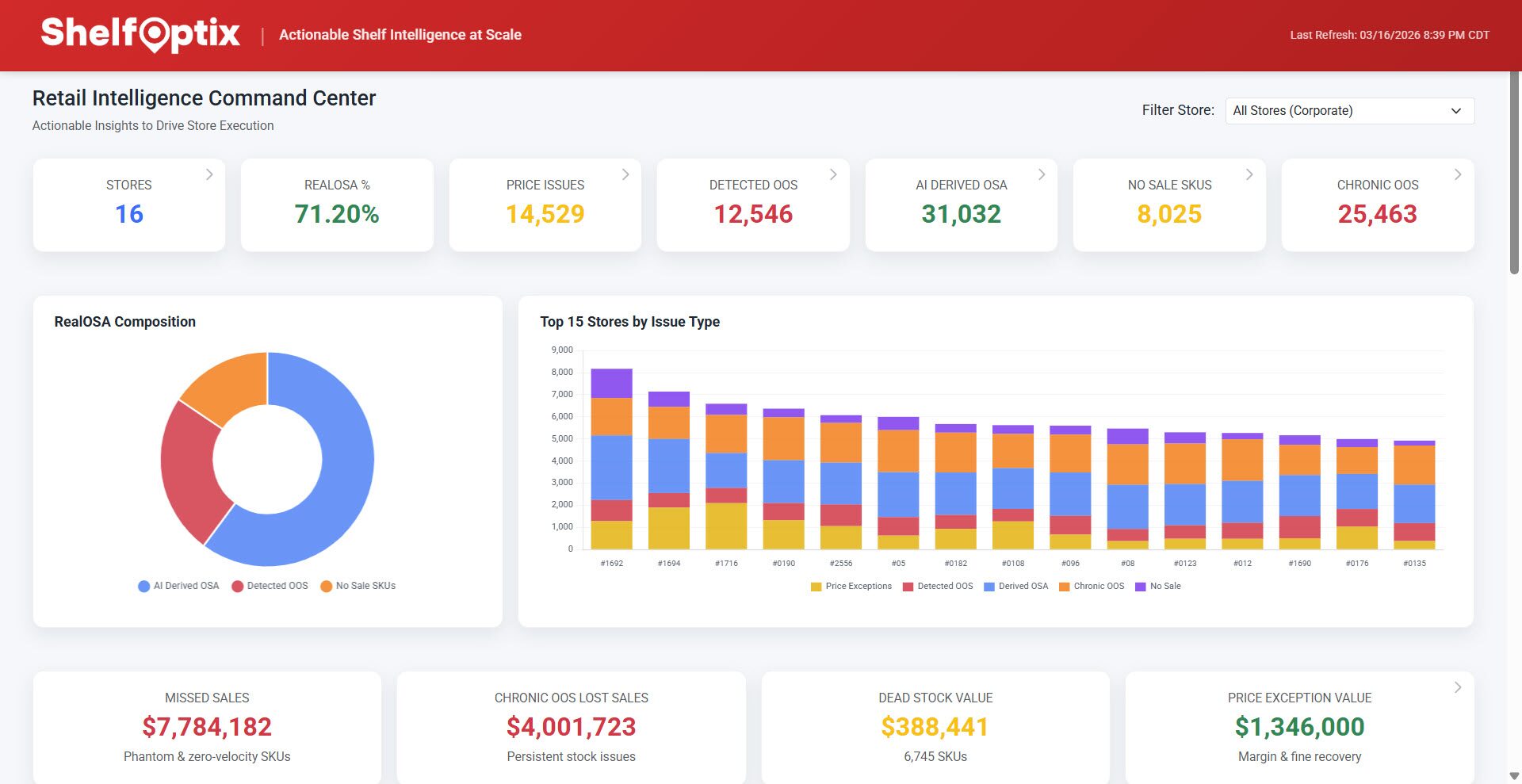
The same scan also counted out-of-stocks, availability issues, chronic out-of-stocks, and planogram exceptions. ShelfOptix delivers all of it as a managed service, with no capital purchase.
The problem: shelf tags drift from system price
A price exception is a shelf tag that does not match the price in the retailer's system. Prices change often. Tags get printed late, hung on the wrong shelf, or left in place after a change. Each one is a small gap between what the shelf says and what the register charges.
A manual audit checks a sample of tags. The tags nobody checks stay wrong, and nobody knows how many there are. The store has a vague sense that tags are off, but no list to work from.
What ShelfOptix did
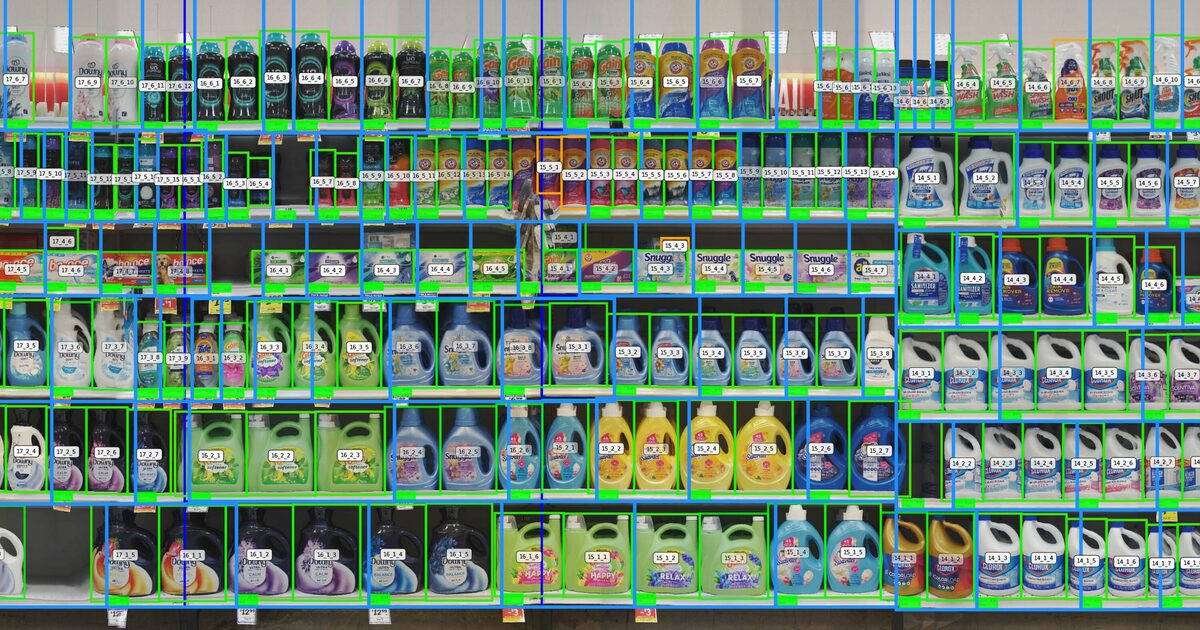
On Monday, October 12, 2026, the ShelfOptix robot scanned the store aisle by aisle. Computer vision read the shelf tags and compared them with system prices. The scan produced a baseline count and a worklist that named each price exception.
The worklist went to the store. Store personnel, with help from ShelfOptix labor, corrected the price exceptions on it. ShelfOptix labor went to price exceptions only. Nobody was assigned to out-of-stocks, availability, or planograms.
On Friday, October 16, 2026, four days after the first scan, the same robot scanned the store again using the same method. The two scans are directly comparable because nothing about the measurement changed.
Results
Price exceptions fell from 646 to 182. Store personnel and ShelfOptix labor cleared 464 of them in four days.
- 72%fewer price exceptions
- 646found October 12, 2026
- 182found October 16, 2026
- 4days between scans
| Scan | Date | Price exceptions |
|---|---|---|
| Scan 1 | October 12, 2026 | 646 |
| Rescan | October 16, 2026 | 182 |
| Change | Four days | 464 fewer, down 71.8% |
Definitions
- Price exception
- A shelf tag whose price does not match the price in the retailer's system.
- Out-of-stock
- A product with no units on the shelf where it belongs.
- Chronic out-of-stock
- An item found empty repeatedly across scans.
- On-shelf availability issue
- A case where a product is not available to the shopper on the shelf, counted from scan data.
- Planogram exception
- A product that is not where the planogram says it should be.
What else the same scan found
The pass of the robot on October 16, 2026 that counted 182 price exceptions also produced four other counts. We show them as a snapshot of what one shelf scan covers. They are opportunities, not outcomes. No labor went to these areas, and we make no claim about them.
- 405 Detected out-of-stocks Store operations act on these.
- 375 AI derived OSA issues, a count of on-shelf availability issues Store operations act on these.
- 453 Chronic out-of-stocks, items repeatedly found empty across scans Replenishment and ordering teams act on these.
- 6,270 Planogram exceptions Merchandising and category teams act on these.
Each count is a worklist the store could take on next with the same loop: scan, fix, rescan. The robot already walked the aisles, so adding a worklist does not add a second audit.
A CPG brand can use the same data for its own items. The counts show how often its products are empty on the shelf, whether they sit where the planogram says they should, and whether their shelf tags carry the right price. Brands rarely control the stores that sell their products, so an independent count gives them a factual starting point for the conversation with the retailer.
What this means for a retailer
A robot scan turns a vague problem into a specific worklist. Instead of a general instruction to check tags, the store received a list of 646 named price exceptions. People could start at the top and work down.
The rescan then verified the work. Because it used the same robot and the same method, the drop from 646 to 182 is a like-for-like comparison. You get ground truth on the result, not a manager's impression of it. The 182 price exceptions that remain are the next worklist.
ShelfOptix with no capex
ShelfOptix sells Scanning-as-a-Service, which is robot-powered shelf intelligence, managed for you. You do not buy robots, and there is no capital purchase. ShelfOptix provides the portable robots, the people who run them in your stores, the computer vision, and the data.
The robots are portable and move between stores. You can start with one store or a set of stores, and you do not need fixed hardware in any of them. You receive ground truth about on-shelf conditions as data and worklists, at scale, on a consistent schedule.
For a retailer, this means better pricing accuracy, on-shelf availability, and planogram execution without the operational burden of owning and running robots. For a CPG brand, it means independent visibility into how your products show up on shelf in stores you do not control. You can see whether they are in stock, on planogram, and priced right.
Method and limits
This paper describes one store, two scans, and four days. Treat it as a documented result from that store, not a forecast for your chain.
Labor was applied only to price exceptions. This paper does not report labor hours, because we do not have a figure to publish. It also makes no estimate of chain-wide dollars. We have not extrapolated the result to other stores or to a full year, and we cite no industry statistics.
The four counts in the section on what else the scan found come from the single scan on October 16, 2026. They describe what the scan covers, and they do not show a result. If you want to test the same approach in your own stores, a larger pilot with more scans will give a firmer answer than this one.
Frequently asked questions
What is a price exception in a shelf scan?
It is a shelf tag whose price differs from the system price for that item. The scan reads each tag with computer vision and flags every tag that does not match.
How did the rescan verify the result?
The same robot scanned the same store again on October 16, 2026, using the same method as the first scan. Because the measurement did not change, the count of 182 compares directly to the 646 found on October 12, 2026.
Did the retailer have to buy robots?
No. ShelfOptix provided the portable robots, the people who ran them, the computer vision, and the data as a managed service. The retailer made no capital purchase.
What else does one scan measure?
The October 16, 2026 scan also counted 405 detected out-of-stocks, 375 AI derived OSA issues, 453 chronic out-of-stocks, and 6,270 planogram exceptions. No labor went to those areas.
Talk to us about a scan
Tell us how many stores you run and which problem you want measured first. We will describe what a baseline scan and a rescan would look like for you.