How retailers and CPGs actually measure and improve OSA — from the $1.73 trillion inventory distortion gap, to phantom inventory and planogram drift, to the 98% gold standard. A pillar reference for the single metric that decides whether a shopper finds the product they came for.
For years, the retail industry has operated under a comforting assumption: if the system says a product is in stock, shoppers can find it on the shelf. That assumption has a price tag. According to IHL Group’s 2025 research, retailers and brands lose an estimated $1.73 trillion globally each year to inventory distortion — with the majority of that loss attributable to products that are absent from shelf at the moment of purchase.
The single metric that quantifies this gap is on-shelf availability, or OSA. It is arguably the most important KPI in physical retail, and it is also the most commonly misreported one. This guide explains what OSA actually is, how retailers and CPG brands measure it today, why most of those measurements overstate reality, what “good” looks like by vertical, and how to move OSA up two to five points without adding store labor.
On-shelf availability is the percentage of a brand’s authorized SKUs that are physically present on the shelf, in the correct location, at the moment a shopper arrives. It is a localized, time-sensitive metric. It measures the final fifty feet of the supply chain — the distance between the backroom and the facing where the product is supposed to live.
Because OSA is defined at the shelf rather than in the warehouse, it is stricter than the inventory metrics many retailers have historically reported. A product can be fully accounted for in the warehouse management system, accurately received at the store, and still have 0% OSA because it is sitting in a backroom cage, mis-shelved three bays over, or blocked by a promotional end-cap.
Precision matters when discussing OSA, because several related terms are frequently — and inaccurately — used interchangeably.
The most important of these distinctions is between OSA and inventory accuracy. A store can have 98% inventory accuracy and 82% OSA simultaneously. The shelf does not care what the WMS says.
Most retailers measure OSA using one of three methods — manual audits, POS-proxy inference, or ground-truth computer vision. They are not equivalent. They differ in accuracy, cadence, labor intensity, and — critically — in the kinds of problems they will never see.
| Method | Accuracy | Cadence | Labor cost | Blind spots |
|---|---|---|---|---|
| Manual audits | 30–60% | Weekly or monthly | $20–$50 per store visit | Human bias, sampling error, reports up to weeks stale |
| POS-proxy | 50–70% | Near real-time (inferred) | Effectively zero — already captured | Phantom inventory, voids, slow-sellers, promotional items |
| Ground-truth AI vision | 95–99% | Daily or multiple times daily | Managed service fee; no store labor | Physical obstructions during capture |
Accuracy and cadence benchmarks compiled from ECR Retail Loss, IHL Group, and internal ShelfOptix deployments.
Manual audits are the legacy baseline. Field merchandisers or corporate teams walk stores on a defined cadence and compare what they see against a planogram. The method is slow, expensive, and notoriously unreliable — research from ECR Retail Loss finds that more than half of self-reported KPI achievements by field teams do not match subsequent ground-truth audits. It is also impossible to scale: a 1,000-store chain that audits each store monthly generates data that is, on average, 15 days old by the time it reaches a decision-maker.
POS-proxy methods infer OSA by looking for anomalies in scan data — a SKU that normally sells eight units a day suddenly showing zero, for instance, gets flagged as a likely out-of-stock. The approach is attractive because the data already exists, and for fast-moving SKUs with stable velocity it produces a reasonable signal. But POS-proxy is fundamentally blind to every failure mode in which no transaction was ever supposed to happen: a phantom inventory situation where the system thinks there are five units so no reorder fires, a void where there is no shelf tag to scan against, or a slow-moving SKU whose zero-sale day looks identical to its normal performance.
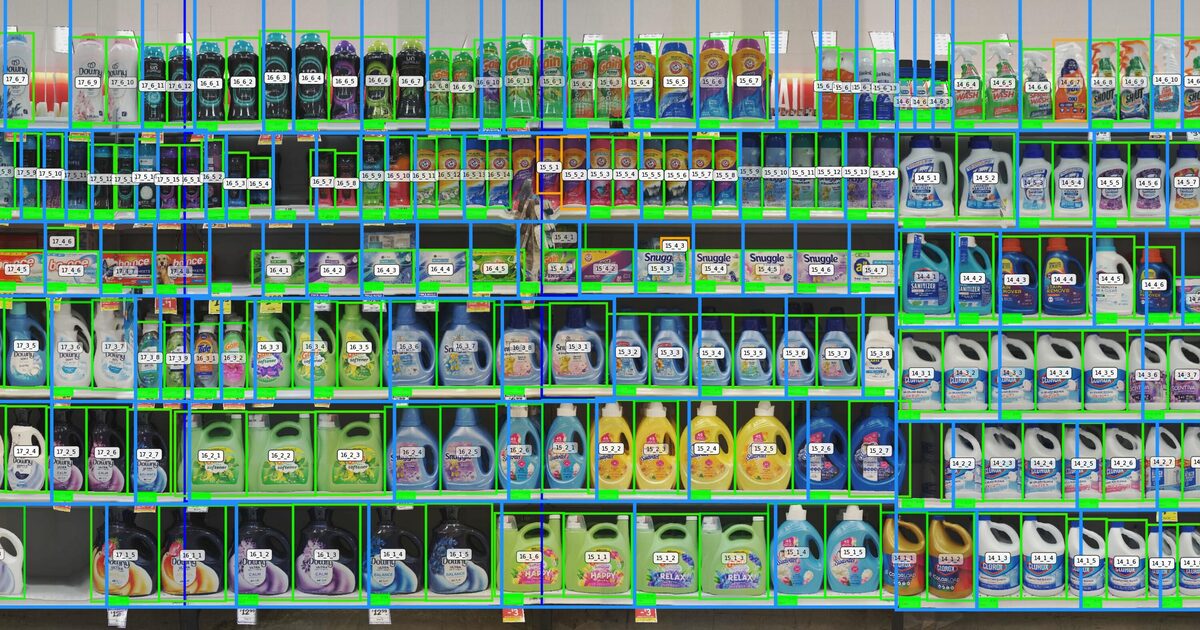
Ground-truth computer vision — captured by autonomous shelf-scanning robots, fixed cameras, or portable robotic scanning services — measures what is actually on the shelf. The image is the record. This method consistently delivers 95–99% accuracy against expert audit and operates at a cadence that is limited only by capture frequency. It is the only approach that reliably exposes phantom inventory, voids, and planogram drift at scale.
If you ask ten retailers what their OSA rate is, you will get ten confident answers. Most of them will be overstated by five to fifteen percentage points. There are three structural reasons.
Phantom inventory is the single largest distorter of retail availability data. It occurs when the system records that units of a SKU are available in the store — because the truck delivered them and no sale was recorded — but the shelf is empty. The product was stolen, damaged, mis-binned, or delivered to the wrong store. Because the computer believes inventory exists, automated replenishment never fires, and the SKU stays out of stock until a human notices.
IHL Group’s 2025 research reports that phantom inventory affects approximately 70% of retailers on a weekly basis. For the retailer’s analytics team, the problem is invisible: POS data looks normal for a slow week, inventory records look normal, and the dashboard shows 97% OSA. Meanwhile, the shelf has been empty for nine days.
Even when product is in the building, it is not always in the right place. Planogram drift describes the cumulative effect of small execution errors — a SKU placed at floor level instead of eye level, a facing pulled forward to hide an empty back row, a tag missing from the shelf edge. Each is small. In aggregate, planogram drift degrades OSA by several points because misplaced or obscured products are functionally invisible to shoppers. Computer-vision ground truth treats these as failures. Manual audits often do not.
The third reason most OSA numbers are wrong is that retailers disagree about what counts as “available.” Some measure availability only against promoted or A-SKUs; others include the entire authorized assortment. Some use a strict definition (product must be at its planogrammed location); others use a lenient one (product must exist somewhere in the section). When OSA improves from 88% to 92%, it is worth asking whether the shelf changed or the definition did.
The honest way to read an OSA number is to ask three questions. What SKU universe is it measured against? Against what benchmark for physical presence? Captured by what method? A 96% OSA against the top-200 A-SKUs, measured weekly by merchandisers, is not the same number as a 96% OSA across the full assortment captured daily by computer vision. The first is easy. The second is hard.
OSA benchmarks vary by format, category velocity, and promotional intensity, but a few consistent ranges emerge from research by ECR Retail Loss, IHL Group, and Coresight.
| Retail vertical | Industry average OSA | Top-quartile OSA | Practical ceiling |
|---|---|---|---|
| Grocery | 91–93% | 95%+ | 98% |
| Mass | 88–91% | 94%+ | 97% |
| Dollar | 82–86% | 92%+ | 96% |
| Promoted / high-velocity items | 80–85% | 92%+ | 96% |
The 98% figure is often described as the “gold standard,” but it is more accurately the practical ceiling beyond which the incremental labor cost of a facing-level fix exceeds the incremental revenue. The more important number is what happens at the bottom of the range. Research from ECR Retail Loss indicates that once OSA falls below 95%, measurable shopper switching behavior begins. Below 90%, shoppers actively remember the retailer as unreliable for the category.
The financial stakes are significant. McKinsey’s end-to-end retail excellence work reports that each one-percentage-point improvement in OSA drives a 20 to 35 basis-point lift in category sales. For a $5 billion grocery chain, moving OSA from 91% to 94% is worth $30–45 million in recovered annual revenue — before counting reduced brand-switching losses or improved trade-partner relationships.
The hardest question in OSA isn’t measurement. It’s what you do after you measure. An accurate gap list with no corresponding action mechanism improves nothing. The breakthrough in the last decade has been coupling ground-truth capture with a prescriptive execution layer — a pre-prioritized worklist that tells a specific associate to fix a specific SKU in a specific location.
Three practices consistently move OSA two to five points without increasing store headcount.
The labor cost of a manual store audit is largely unproductive: the audit itself produces information, but the audit process does not fix anything. Replacing audits with autonomous or managed image capture preserves the information while freeing associate hours for replenishment. For a 1,000-store chain, redirecting ten hours of weekly audit labor per store toward closing exception lists yields the equivalent of a 5,000-hour weekly execution uplift at zero incremental cost.
Most store-execution tools still output exceptions alphabetically or by aisle. The result is predictable: associates fix the top of the list, which happens to be the least-important SKUs. Ranking exceptions by projected revenue impact — unit velocity times margin times time-to-stock-out — concentrates effort on the fixes that actually move the category.
Phantom inventory is the hardest failure mode to fix because it is invisible to most systems. The only way to close the loop is to detect phantom inventory at the shelf (via vision or associate report), trigger an on-hand adjustment at the store level, and feed the correction back into the replenishment engine so the reorder fires. Retailers that implement a closed phantom-inventory loop routinely see OSA improve 1–2 points within 90 days.
“True shelf intelligence isn’t about more data — it’s about the speed of correction. Ground-truth imagery replaces ‘I think’ with proof, allowing teams to fix today’s shelf rather than explain last month’s failure.”
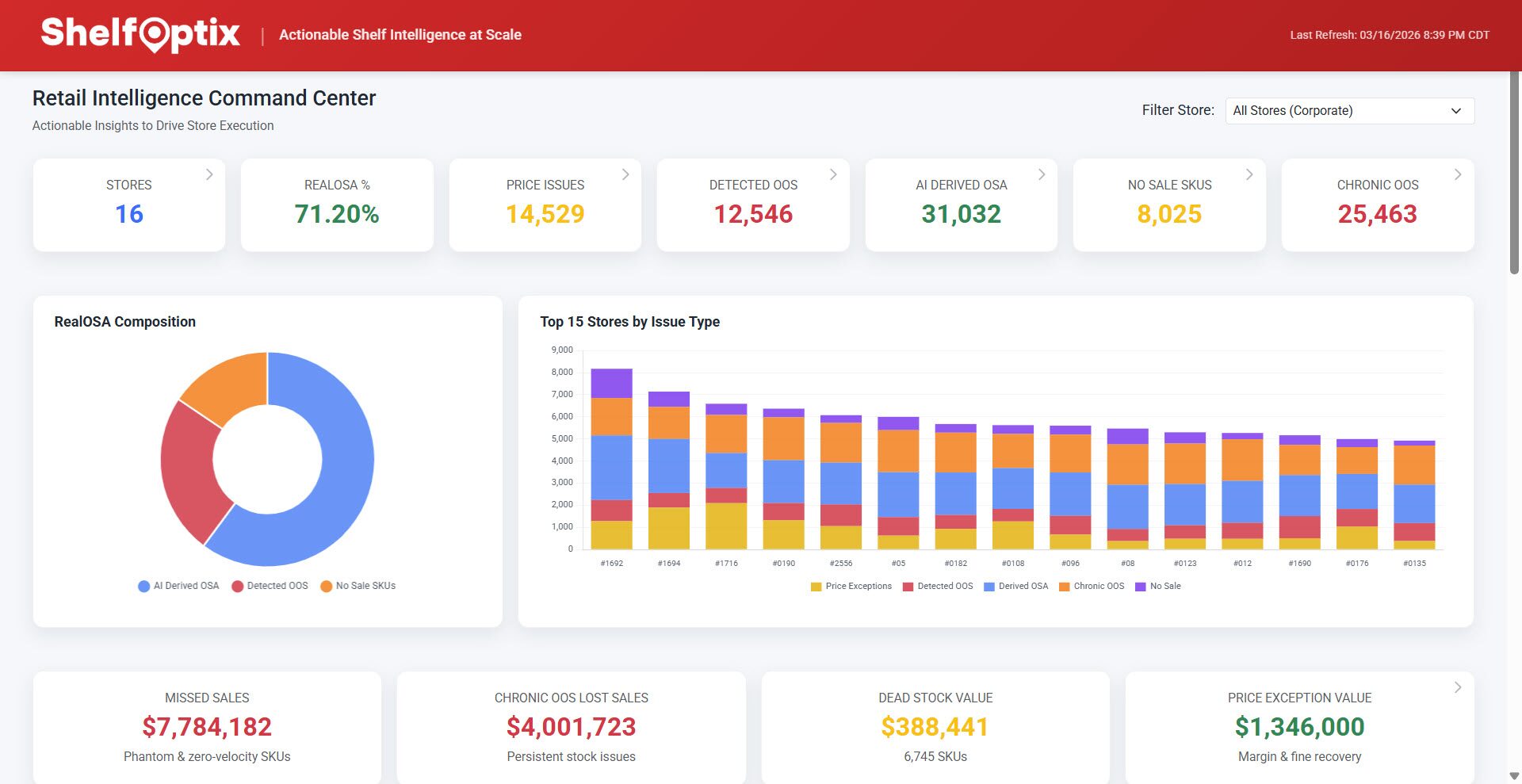
ShelfOptix is built around the premise that OSA is only useful if it drives action. The service captures ground-truth shelf imagery through portable robotic scanning, processes it through an AI analytics layer that identifies voids, phantom inventory, planogram drift, and price-tag failures at SKU level, and delivers a prioritized execution worklist to the people who can act on it. See how one store cut price exceptions 72% in four days.
The execution layer is what separates shelf intelligence from shelf reporting. With 15,000 Driveline Retail associates available to remediate flagged exceptions, ShelfOptix closes the loop from capture to correction inside the same program. No additional store labor is required from the retailer, and no capital investment in robotics is required from the brand.
For retailers operating at 91–93% OSA today, the path to 95%+ is not another reporting dashboard. It is a ground-truth capture cadence, a prescriptive worklist, and the execution capacity to close gaps before shoppers leave the aisle. That is the operating model OSA was always meant to enable.
On-shelf availability (OSA) is a retail KPI measuring the percentage of time a product is physically present and visible on the shelf for purchase. It is typically measured through three methods: manual audits (field teams), POS-proxy (inferring stock from scan data), or ground-truth computer vision (autonomous robots or fixed cameras). While POS data provides estimates, computer vision offers the highest accuracy by verifying the physical presence of the SKU.
In the retail and consumer packaged goods (CPG) industry, OSA stands for On-Shelf Availability. It represents the critical “moment of truth” where a shopper’s intent to buy meets the physical presence of the product. High OSA indicates a healthy supply chain and disciplined in-store execution, while low OSA results in immediate revenue loss, brand switching, and long-term erosion of customer loyalty.
To improve OSA without increasing labor costs, retailers are shifting toward autonomous ground-truth capture. By utilizing shelf-scanning robots or fixed computer vision cameras, the system identifies gaps automatically. These insights are then converted into “actionable exception lists” for store associates. This ensures that employees spend time only on high-value restocking tasks rather than manual audits, effectively increasing replenishment velocity while keeping payroll stable.
Low OSA is driven by several systemic failures: inaccurate demand forecasting (upstream), replenishment lag between the backroom and the floor (execution), and phantom inventory (data discrepancies). IHL Group research indicates that 70% of retailers face weekly inventory accuracy issues. Other contributors include planogram drift, where products are mis-shelved, and organized retail crime, which creates voids that automated ordering systems fail to detect.
Inventory accuracy measures whether a product exists somewhere in the store’s building or warehouse according to the digital ledger. On-shelf availability (OSA) is stricter: it measures if the product is physically on the selling shelf in the correct position. A product can be 100% accurate in the warehouse management system (WMS) but have 0% OSA if it remains sitting in the backroom or a misaligned bay.
For grocery retailers, the industry “gold standard” benchmark for OSA is 98% or higher. ECR Retail Loss research suggests that once OSA falls below 95%, shoppers begin to exhibit measurable switching behavior — either choosing a competitor’s brand or leaving the store entirely. While top-quartile retailers maintain 95%+, the practical ceiling for most operations is 97–98% before the cost of additional labor yields diminishing returns.
Stop relying on POS-proxies and start seeing your shelf the way your customers do. ShelfOptix delivers ground-truth OSA visibility at retail scale — fully managed, continuously updated, and backed by 15,000 associates ready to act.
Thanks for reaching out. A member of the ShelfOptix™ team will be in touch with you right away.