Why standalone AI fails to resolve in-store reality — and why a fully managed Scan → Insights → Action model is the only way to close the gap between what retailers think is happening and what is actually happening on the shelf.
Retailers are flying blind. They know what is in the backroom, but they have no idea what is actually on the shelf. For decades, retail management has relied on theoretical inventory data to assess store performance, assuming that if a product has been delivered to the backroom, it is inherently available to the consumer.
That assumption frequently collapses upon contact with the in-store reality. Consumers routinely face empty shelves and disorganized displays, highlighting a disconnect between digital inventory systems and actual shelf conditions. Retailers must close the gap between what you think is happening and what is actually happening in-store. Attempting to bridge this divide requires moving beyond raw data collection and focusing entirely on actionable store execution.
In recent years, the industry has witnessed a massive influx of technologies designed to monitor shelf truth. The integration of computer vision in retail promised to revolutionize the way store-level data was collected and analyzed. In theory, smart cameras and sensors could identify missing items instantaneously.
However, many retail AI vision solutions have struggled to consistently improve the customer experience because they focus on the wrong commercial outcomes. A critical error made by early adopters was falling victim to over-indexing on AI-led approaches and adopting an inventory-first positioning. Many developers attempted to sell retailers a complex platform ecosystem, which ShelfOptix™ correctly reframes as a shelf intelligence solution. These early iterations often relied on autonomous robots or pushed the concept of real-time continuous monitoring. Rather than solving operational bottlenecks, these systems created new ones.
When a store is subjected to continuous monitoring without a filtered workflow, frontline employees are bombarded with an unceasing barrage of digital alerts. A notification stating that an aisle is disorganized is merely an observation; it lacks the prioritized direction necessary to execute a fix.
This operational paralysis is known as data fatigue. Unfiltered retail AI vision solutions turn into a stressful distraction, demanding attention without providing a clear pathway to resolution. Consequently, employees tune out the noise, and the sophisticated technology becomes nothing more than a highly expensive, passive observer of store conditions.
“You can’t fix what you can’t see — but seeing without action is just data fatigue with better dashboards.”
Overcoming the limitations of standalone computer vision in retail requires a fundamental shift in how technology is deployed and managed. ShelfOptix™ addresses this by discarding the hardware-centric approach in favor of a service-oriented model. ShelfOptix™ is defined as a fully managed, portable, robot-powered shelf intelligence service. This store-friendly model guarantees no CapEx, no ownership, no operational burden.
The defining commercial advantage of this approach is its financial and operational structure. With ShelfOptix™, there is no robot purchase or lease required. Retailers should focus on insights and outcomes rather than ownership of hardware.
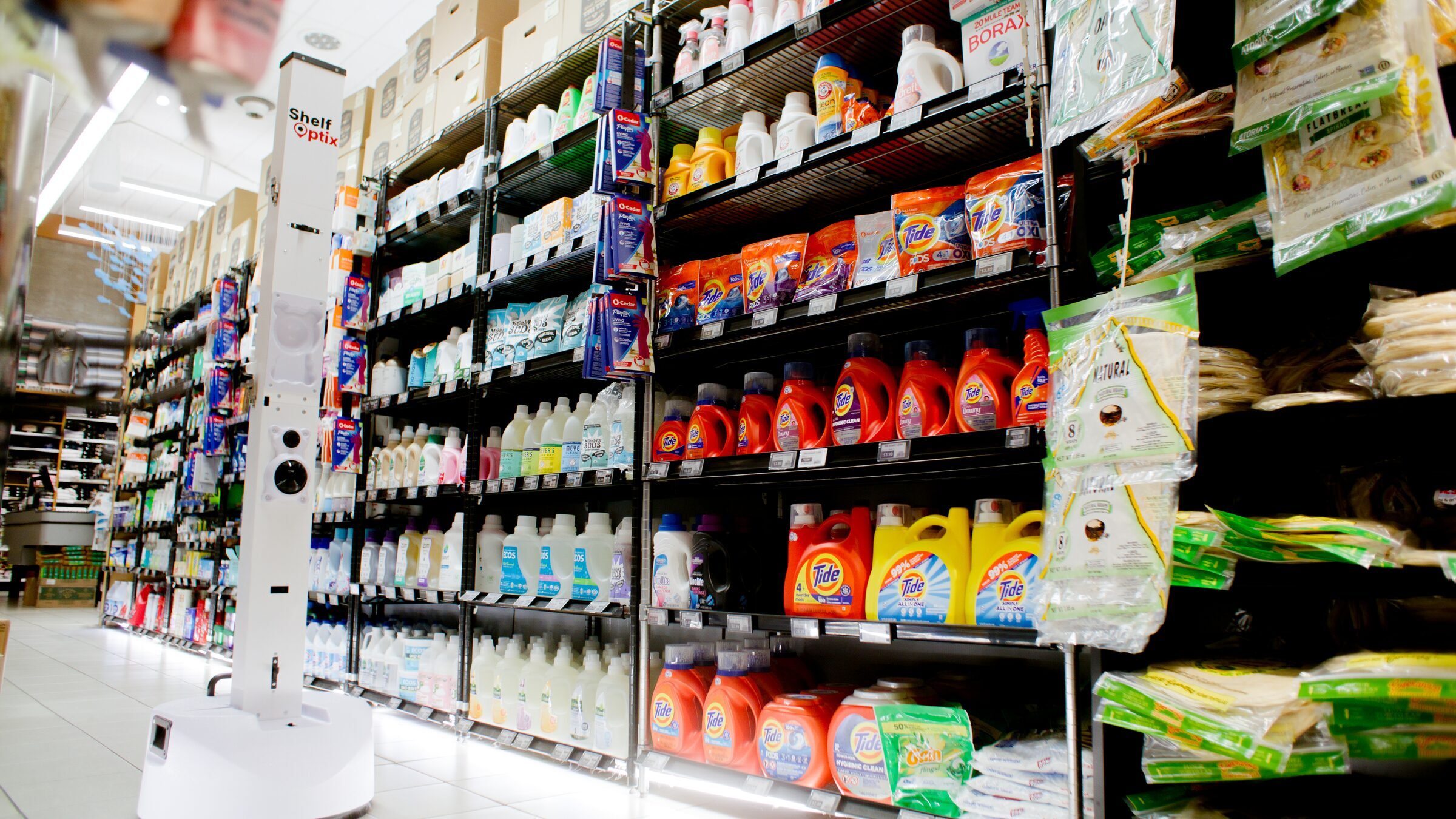
The service is delivered through portable, human-escorted robots, which ensures that the technology remains a low-lift integration for staff. Because it is fully managed for you, store leadership can focus entirely on operational outcomes rather than maintaining complex machinery. It provides timely, consistent visibility rather than the overwhelming demand of continuous monitoring — the same philosophy that underpins our shelf-intelligence vendor evaluation guide.
To definitively close execution gaps, any technological implementation must translate observation into directed labor. The foundation of all messaging and operational philosophy within ShelfOptix™ is its core model: Scan → Insights → Action. Every piece of content and every operational directive must answer what problem exists, why it matters commercially, how ShelfOptix™ solves it, and what action follows.
The process begins when you scan the shelf. Human-escorted robots equipped with AI-enabled computer vision conduct highly accurate shelf image capture. These high-resolution images deliver ground-truth shelf visibility at scale — scalable, repeatable, and consistent.
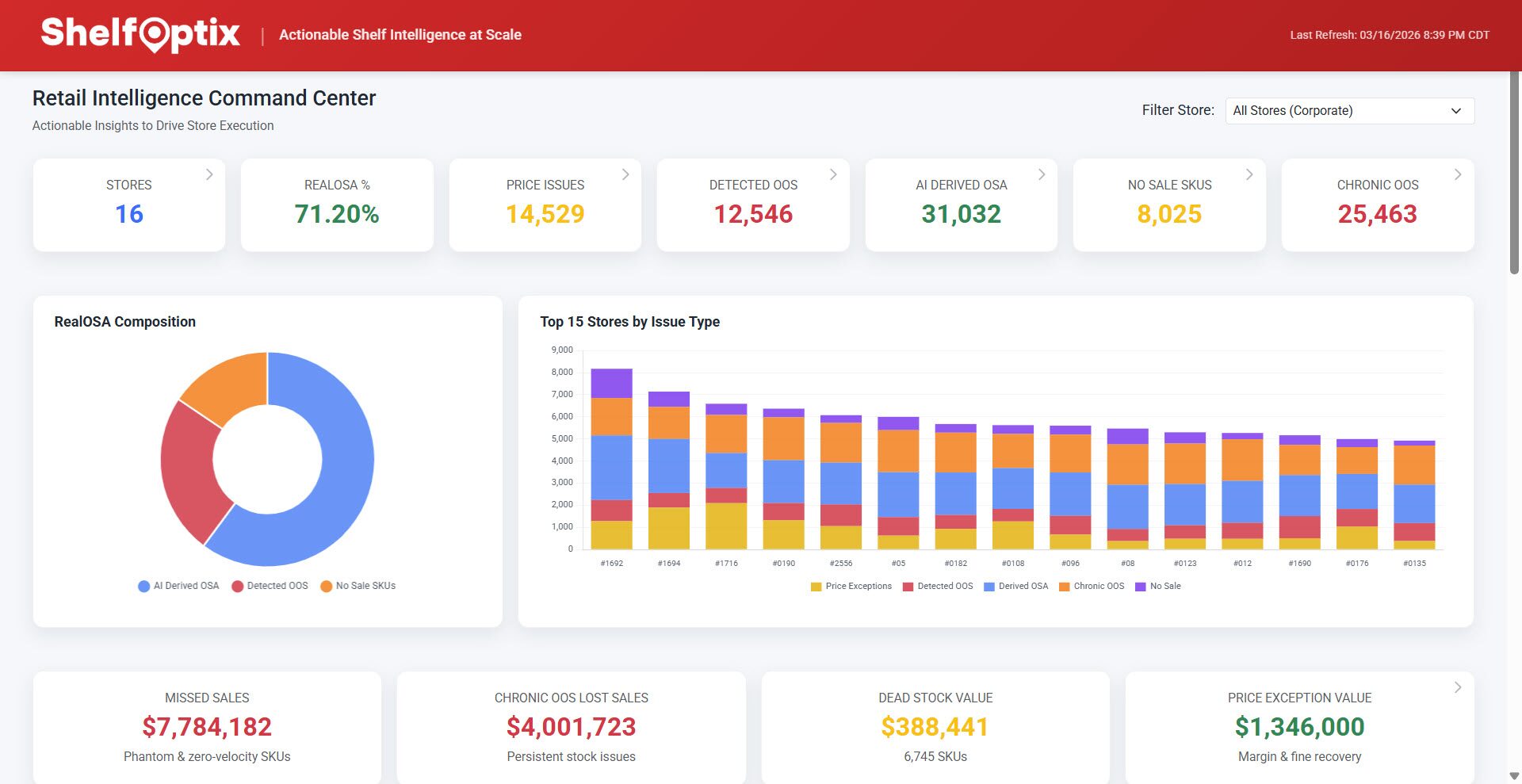
Raw images are useless without interpretation. ShelfOptix™ algorithms analyze the visual data to establish the shelf truth — isolating shelf-level gaps such as phantom inventory, out-of-stocks, and pricing errors. This step filters out the noise and surfaces only what actually impacts your bottom line.
The final and most crucial step is to enable action. Instead of issuing a list of generic alerts, ShelfOptix™ delivers actionable insights — signals routed to frontline labor to fix what matters. Visibility translates directly to action, because you can’t fix what you can’t see.
When store teams are empowered to turn strategy into execution, they can systematically target and resolve the specific operational failures that erode profitability and frustrate consumers. ShelfOptix™ provides the precise visibility required to address these highly specific execution gaps.
The primary directive is not generic inventory optimization. By targeting both base and chronic out-of-stocks, stores effectively reduce OOS while validating both base and real on-shelf availability to improve OSA. High on-shelf presence guarantees shoppers find the items they intend to purchase.
Consumer trust is heavily reliant on accurate labeling. ShelfOptix™ helps correct pricing issues by maintaining rigorous pricing accuracy across both everyday and promotional items — ensuring the price displayed matches the register and protecting retailers from compliance fines and consumer dissatisfaction.
Brands invest heavily in in-store promotions, yet compliance can be mixed. ShelfOptix™ helps validate promo execution at both the display and shelf levels. Continuous visibility strengthens planogram compliance, ensuring the store’s layout reflects intended partner agreements.
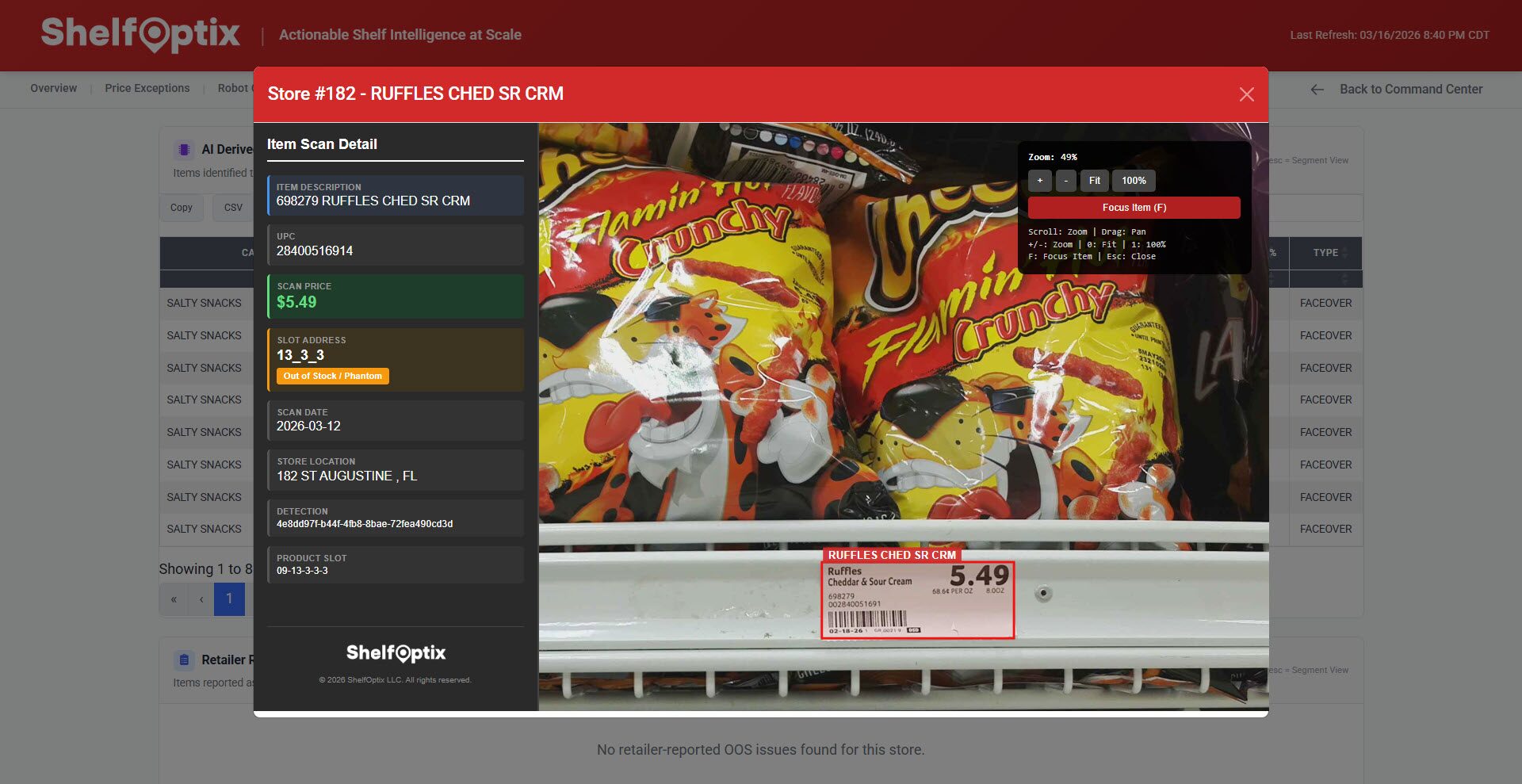
One of the most challenging retail problems is phantom inventory — items your system believes are in stock but are physically missing from the shelf. Ground-truth visibility lets ShelfOptix™ detect phantom inventory and trigger accurate replenishment, eliminating hidden dead stock.
Ultimately, deploying sophisticated technology in a retail environment must be justified by its commercial outcomes. The ultimate objective is to improve store performance and improve store execution.
When a retailer successfully transitions from fragmented visibility to coordinated execution, the financial benefits are immediate and substantial. By ensuring products are accurately priced and physically available, stores recover lost sales that would otherwise go to competitors. This operational tightening leads directly to increased sales. Detecting pricing errors and phantom inventory helps protect margin and reduce margin leakage.
Most importantly, bridging the execution gap results in a vastly improved customer experience. Shoppers are no longer met with the frustration of empty shelves or incorrect price tags. By relying on a human-escorted, fully managed shelf intelligence service rather than standalone hardware, retailers can finally achieve visibility at scale — seamlessly transitioning from scan to insights to action and ensuring that their digital strategies perfectly align with their in-store reality.
The retail execution gap is the persistent disconnect between what a retailer’s digital inventory systems believe is happening on the shelf and the physical reality the consumer encounters. Theoretical inventory data may show product as available, while shoppers face empty shelves, disorganized displays, or incorrect prices in the aisle.
Many early retail AI vision solutions over-indexed on continuous monitoring and inventory-first positioning. Without a filtered workflow, frontline employees are bombarded with unprioritized alerts and observations, creating data fatigue. The technology becomes a passive observer rather than a directed labor signal, so store conditions do not improve.
Scan → Insights → Action is the core operational model behind ShelfOptix™. Portable, human-escorted robots scan the shelf using AI-enabled computer vision to capture high-resolution imagery. Algorithms generate insights by isolating shelf-level gaps such as phantom inventory, out-of-stocks, and pricing errors. Those insights are then routed as prioritized actions to frontline labor to fix what matters.
Data fatigue is what happens when frontline employees are overwhelmed by an unfiltered stream of alerts from continuous monitoring systems. Managed shelf intelligence avoids this by providing timely, consistent visibility instead of constant noise, filtering observations into prioritized, store-specific action lists that workers can actually execute.
Closing the execution gap directly improves on-shelf availability, reduces out-of-stocks, validates promotional and planogram compliance, and reconciles digital and physical stock to eliminate phantom inventory. The financial result is recovered sales, protected margin, and a measurably better customer experience.
Closing the execution gap requires more than another dashboard. ShelfOptix™ delivers a fully managed, human-escorted shelf intelligence service that turns scans into insights and insights into directed labor — with no CapEx, no ownership, and no operational burden on store teams.
Thanks for reaching out. A member of the ShelfOptix™ team will be in touch with you right away.