Eight criteria, a head-to-head comparison grid across the vendors you’ll likely encounter, and a 10-question RFP checklist designed to surface what actually predicts a successful deployment.

Vendor evaluation in shelf intelligence is harder than in adjacent categories because the underlying technologies differ — not just the user interface. A camera mounted overhead, a robot rolling through aisles, a weight sensor under a facing, and a managed analyst service all promise to measure on-shelf availability (OSA), but they capture data on different cadences, with different accuracy profiles, and with very different operational footprints. Two vendors can both report a 95% accuracy figure and mean entirely different things by it.
That makes apples-to-apples comparisons difficult. RFPs that work for shelf-management software (“show me your dashboard”) miss the questions that decide whether you’ll see ROI in 90 days or 18 months. This guide gives you a structured way to compare vendors across the criteria that actually predict outcomes — and a buyer’s checklist you can drop straight into your next RFP.
Almost every shelf-intelligence vendor falls into one of four deployment models. The model dictates more about your day-to-day experience than the brand on the box.
Own-the-robot. The retailer or brand purchases or leases an autonomous robot that scans shelves on a fixed cadence. Strength: deep store presence and high data density. Limitation: heavy capex, IT infrastructure, and store-staff training; the customer carries the operational burden.
Managed scanning service. A third party deploys portable autonomous robots and delivers data as a service. Strength: fast time-to-deploy, predictable monthly cost, no permanent fixtures. Limitation: visit-based cadence rather than continuous; coverage depends on the provider’s route density.
Ceiling cameras. Fixed cameras mounted overhead capture continuous video of shelf state. Strength: always-on coverage with no in-aisle hardware. Limitation: per-store installation cost, sightline gaps, and harder execution on tall or deep gondolas.
Smart-shelf weight sensors. Sensors embedded in shelves detect product removal by weight or RFID. Strength: real-time on-shelf signal at SKU level. Limitation: high installation cost per linear foot and meaningful retrofit work for existing fixtures.
1. Measurement methodology and OSA accuracy. A 95% claim is meaningless without context. Ask how accuracy was measured, against what baseline (manual audit, RFID, POS reconciliation), and at what SKU and store-format level. The same headline number, derived differently, can mean opposite things.
2. Category and store-format coverage. Some vendors handle dry grocery well but stumble on apparel, refrigerated, or non-rectangular gondolas. Confirm the technology has been validated in the formats and categories you actually care about — and ask for the validation data, not just the customer logos.
3. Cadence. Continuous capture (cameras), daily robot fleets, weekly or biweekly managed visits all change what you can detect. A daily out-of-stock spike is invisible to a biweekly capture; a weekly planogram compliance review needs at least weekly data.
4. Time-to-first-data. Fixed-camera installs and owned-robot rollouts often take months. A managed scanning service can be capturing your stores within weeks. Match the deployment timeline to your decision cycle, not the other way around.
5. Data-handoff format and integration. APIs, flat files, prebuilt dashboards, and direct integrations with your trade-promotion or replenishment systems each reduce friction differently. Confirm how the data lands in the systems your team already uses every day.
6. Total cost of ownership. Hardware, software, installation, integration, change management, and ongoing support — model the three-year cost, not the first-year quote. Some models are quoted as low capex but carry significant operational expense in store hours.
7. Operational burden on store staff. A robot that requires associates to clear aisles, manage charging, or escalate exceptions has a hidden labor cost. The lighter the burden on store teams, the smoother the rollout and the more durable the program over time.
8. Roadmap and partner ecosystem. Shelf intelligence is still a young category. Vendors with consistent investment in coverage expansion, category support, and integrations with the broader retail tech stack are likelier to be there for you in three years.
AiFi. AiFi is a US-based provider of camera-based autonomous retail systems. The platform was designed primarily for cashierless store experiences, with shelf-state inference as a byproduct of the core checkout-free architecture. Brands and retailers evaluating AiFi for shelf intelligence specifically should confirm what OSA, planogram compliance, and SKU-level reporting are productized today versus part of a broader autonomous-store deployment.
Focal Systems. Focal Systems, now part of DoorDash Labs, deploys ceiling-mounted cameras with computer vision to monitor on-shelf availability and pricing across grocery and mass retail. The fixed-camera architecture supports continuous capture and was validated in large-format grocery. Implementation requires per-store hardware installation and overhead infrastructure work, so time-to-first-data and total installation cost are central items in any evaluation.
NielsenIQ Brandbank. NielsenIQ Brandbank is a global product-content and image-services business, adjacent to but not centered on in-store shelf measurement. Brands often encounter Brandbank during shelf-intelligence vendor research because the underlying SKU image library and product attribution data are widely used. For OSA and live shelf-state measurement specifically, Brandbank is typically a complement rather than a primary deployment.
Pensa Systems. Pensa Systems, headquartered in Austin, develops autonomous shelf intelligence using a combination of computer vision and modeling to estimate on-shelf availability and inventory. Pensa has historically focused on CPG-brand use cases, providing visibility into competitive shelf state across retail accounts. Buyers should confirm current store-format coverage, retailer-permission status in their target chains, and how Pensa’s outputs reconcile with retailer-side data.
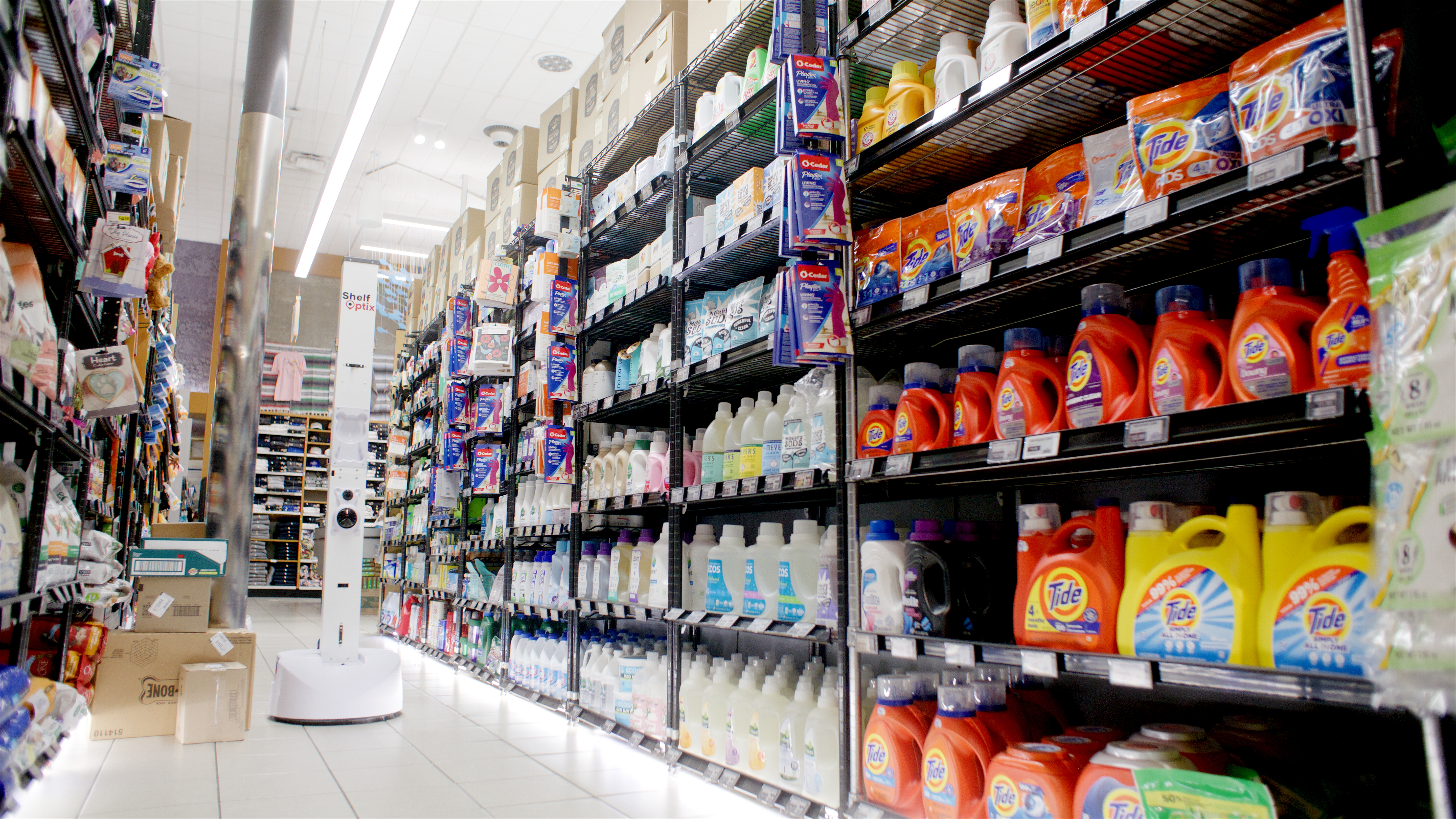
ShelfOptix. ShelfOptix is a managed shelf-intelligence service that uses portable autonomous robots to capture ground-truth on-shelf data for CPG brands and retail chains. The managed scanning service model removes capex and permanent installation work; ShelfOptix scans the store on a defined cadence and delivers OSA, planogram compliance, share-of-shelf, and exception data. Buyers should compare cadence, route density, and integration options against their decision timelines.
Simbe Robotics. Simbe Robotics is the maker of Tally, an autonomous shelf-scanning robot deployed inside retailer stores. The own-the-robot model places fixed hardware in each location, supporting daily or higher-frequency captures. Simbe partners with several major US grocers. Buyers should evaluate per-store capex or subscription cost, IT and floor-space requirements, and how often Tally captures each aisle relative to their OSA decision cadence.
Trax Retail. Trax Retail provides image-recognition technology, traditionally captured via field-team mobile devices and increasingly via fixed cameras and partner robots. Trax serves CPG brands globally and has built a shopper-mission analytics layer on top of shelf data. Because capture method varies across deployments, buyers should confirm exactly which capture modality is being proposed for their stores and how cadence and coverage are guaranteed.
Trigo. Trigo is an autonomous-retail infrastructure provider headquartered in Tel Aviv, focused primarily on cashierless store experiences for grocery chains. Like other autonomous-store platforms, Trigo’s shelf-state outputs are a byproduct of the broader checkout-free architecture rather than a standalone shelf-intelligence product. Buyers interested in OSA-only use cases should confirm whether Trigo offers a shelf-only deployment or whether the full autonomous-store rollout is required.
| Criterion | AiFi | Focal Systems | NIQ Brandbank | Pensa Systems | ShelfOptix | Simbe Robotics | Trax Retail | Trigo |
|---|---|---|---|---|---|---|---|---|
| Methodology | Cameras (autonomous store) | Ceiling cameras | Image / product data | Autonomous CV | Portable robots (managed) | Owned robot (Tally) | Image recognition | Cameras (autonomous store) |
| Format coverage | Convenience / small box | Grocery / mass | SKU data (global) | Mass / grocery | Multi-format | Grocery | Mass / grocery (global) | Grocery |
| Cadence | Continuous | Continuous | — | Per visit | Scheduled visits | Daily / per route | Per capture | Continuous |
| Time to first data | — | Months | — | Weeks–months | Weeks | Months | Weeks | — |
| Data handoff | — | Dashboard / API | Image / data feeds | Dashboard / API | Dashboard / API / files | Dashboard / API | Dashboard / API | — |
| TCO model | Capex + install | Capex + install | Subscription | Subscription | Subscription (managed) | Capex + subscription | Subscription | Capex + install |
| Operational burden | Store install | Store install | Low (data only) | Low–moderate | Low (provider-operated) | Robot ops + charging | Varies by capture | Store install |
| Roadmap focus | Autonomous retail | OSA / pricing | SKU content | CPG visibility | Coverage / cadence | Retailer ops | CPG analytics | Autonomous retail |
| Public information as of April 2026; verify directly with vendor. | ||||||||
Drop these ten questions into any shelf-intelligence RFP. Each is written so the answer is testable, not aspirational.
The decisive choice in shelf intelligence is rarely which sensor a vendor uses; it is whether the buyer wants to operate the system or wants the data.
Step 1 — Scope. Pick a focused window: a defined geography, a store-count band (typically 10–50 stores), and one or two high-priority categories. Define the success metric — OSA lift, OOS reduction, share-of-shelf change — before the pilot starts so the post-pilot review is unambiguous.
Step 2 — Baseline. Capture a pre-pilot baseline using whatever data you trust today: manual audits, mystery shoppers, POS modeling, or retailer-reported figures. A pilot without a defensible baseline is a demo, not an evaluation.
Step 3 — Instrument. Stand up the data feed, dashboards, and exception workflow before the first capture lands. The fastest way to lose pilot momentum is to receive ground-truth data nobody on your team owns.
Step 4 — Review. At day 90, compare the agreed metric against baseline and against the same metric in matched non-pilot stores where available. Calculate ROI from the lift, not from the gross data volume. Decide on rollout, expansion, or stop based on the evidence.
If you’d like a starting framework tailored to your category and store count, we can scope a pilot together — see Services.
The eight vendors most often shortlisted are AiFi, Focal Systems, NielsenIQ Brandbank, Pensa Systems, ShelfOptix, Simbe Robotics, Trax Retail, and Trigo. They cluster into four deployment models: camera-based autonomous retail, ceiling cameras, image and product-data services, and autonomous shelf-scanning robots — with managed scanning services overlaying the robot category. The right vendor depends on your store formats, target cadence, and operational appetite.
These four sit on different deployment models. Simbe Robotics deploys owned in-store robots; Trax Retail captures imagery through mixed modalities including field teams and partner devices; Pensa Systems uses computer-vision-based autonomous shelf intelligence; ShelfOptix delivers a managed scanning service using portable autonomous robots. Compare them on cadence, time-to-first-data, total cost of ownership, and operational burden — not on dashboard features alone.
Cover methodology and OSA accuracy validation, category and store-format coverage, capture cadence, time-to-first-data, data-handoff format, three-year total cost of ownership, operational burden on store staff, and roadmap. Then ask for a comparable reference customer and a clear data-portability path at contract end. The buyer’s checklist in this guide gives ten ready-to-use questions you can adapt directly.
With an owned robot, you buy or lease the hardware, host it in-store, and operate the data and exception workflow yourself. With a managed scanning service, a third party brings portable robots in on a defined cadence and delivers ground-truth data without permanent fixtures. The owned model gives higher capture frequency; the managed model gives lower capex, faster start, and less operational lift on store teams.
Establish a pre-pilot baseline for your target metric (OSA, OOS rate, share-of-shelf, planogram compliance). Measure the same metric in pilot stores during the 90-day window and in matched control stores. Convert the lift to incremental units, then to incremental revenue using your category economics. Subtract the pilot cost. The result is your category-level ROI.
Skip the capex and the operational lift. ShelfOptix delivers a managed scanning service designed for fast time-to-data and consistent coverage at scale — with 15,000 associates ready to act on every insight.
Thanks for reaching out. A member of the ShelfOptix™ team will be in touch with you right away.