The hidden driver behind 80% of retail out-of-stocks — and why your POS can’t see it. A pillar guide to what phantom inventory actually is, the five causes that account for almost all of it, why current systems are blind to it, and how retailers actually detect it at the shelf.

Phantom inventory is stock that a retailer’s systems record as available but that is not actually on the shelf for a shopper to buy — most often because the item is misplaced, in the backroom, damaged, stolen, or mis-recorded at receiving. This fundamental disconnect between digital records and physical reality creates a permanent blind spot in the perpetual inventory file, effectively freezing automated replenishment because the software assumes the shelf is fully stocked.
Also known as ghost inventory, phantom stockouts, phantom OOS, or book-vs-physical inventory variance, it is the most financially damaging subset of total inventory record inaccuracy (IRA). While IRA covers both directions of error — the system shows zero but the shelf has five, or the system shows five and the shelf has zero — phantom inventory specifically refers to the latter, which is significantly more damaging because it suppresses the corrective signal in every connected system.
Phantom inventory occurs when the master digital ledger — the perpetual inventory (PI) file — decouples from the physical reality of the store floor. Modern retail supply chains operate on the assumption that an item scanned in at the receiving dock will eventually scan out at the point of sale. When an item disappears from the physical world without a corresponding digital scan, phantom inventory is created.
To manage on-shelf availability (OSA) effectively, retail-ops and CPG revenue-growth-management leaders must distinguish phantom inventory from adjacent execution failures.
The danger of phantom inventory lies in its ability to paralyze automated retail supply chains. Modern operations rely on Enterprise Resource Planning (ERP) and Inventory Management Systems (IMS) to execute algorithmic reordering. When a physical item is lost, stolen, or misplaced without a digital record being updated, the POS system never registers a sale — and the IMS keeps an artificially high on-hand balance.
The safety-stock parameters that should trigger a reorder when inventory drops below a threshold are never breached. The replenishment system enters a prolonged state of inventory freezing: the shelf stays empty indefinitely because the algorithm assumes the store is adequately supplied. Because the system reports healthy stock levels, store-ops teams receive no automated alerts to audit the aisle. Field merchandisers assume the SKU is simply experiencing a period of low demand. Shoppers leave empty-handed.
The chain reaction is devastating: phantom inventory means replenishment doesn’t trigger, the shelf stays empty, the POS shows “in stock,” store operations doesn’t audit the gap, and sales are permanently lost. Often referred to as the “Trillion Dollar Phantom” by retail analysts, IHL Group estimates that out-of-stock situations cost global retailers nearly $1 trillion in lost sales annually, driven heavily by underlying inventory distortion. With phantom inventory accounting for roughly 8% of all inventory loss, the inability to synchronize digital systems with the physical shelf represents one of the largest margin drains in the CPG and retail ecosystem.
Inventory drift is rarely caused by a single catastrophic failure. It is the accumulation of thousands of micro-errors across the supply chain. Five mechanisms create almost all phantom inventory, ordered below by typical share of disruption volume.
Whether driven by organized retail crime, opportunistic shoplifting, or employee sweethearting at checkout, theft removes physical inventory without updating the digital ledger. With total retail shrink reaching $112.1 billion in 2022 per the National Retail Federation, the corresponding volume of unrecorded product creates massive phantom stockouts across high-value, high-velocity categories. Operational signal: the perpetual inventory record stays high while POS sales drop to absolute zero in a historically high-theft category.
Items are frequently moved within the store by undecided shoppers who abandon them in the wrong aisle, or improperly shelved by associates rushing through nighttime replenishment. To avoid the appearance of empty shelves, store staff also execute a plug — pulling adjacent products over an empty slot to mask the visual gap. Operational signal: a physical gap exists at the planogrammed location while the adjacent “plugging” product shows an artificial spike in recorded sales velocity.
Often called the “last-meter problem,” inventory is physically present in the store’s backroom but never makes it to the sales floor. If the replenishment cycle breaks down due to labor shortages, poor backroom organization, or mislabeling, the system accurately reports the item as in-store. To the shopper, who cannot access the backroom, it is a phantom out-of-stock. Operational signal: the perpetual inventory file shows an on-hand quantity that far exceeds the physical shelf’s holding capacity, yet the shelf is visually bare.
Errors at the loading dock introduce phantom inventory before the product ever reaches the sales floor. Vendor-managed drop-offs with inaccurate advance shipping notices, mis-keyed quantities by receiving staff, the acceptance of damaged pallets without processing financial claims, and poor returns management all inflate the perpetual inventory file artificially. Operational signal: entire shipments missing from the backroom, or unexplained phantom spikes in recorded inventory immediately following a vendor delivery date.
In fast-paced grocery and mass environments, damaged goods (a shattered jar, a torn package) and expired perishables are frequently discarded by associates to maintain aisle cleanliness and food safety. If these items are swept away without being formally scanned out via a markdown or spoilage terminal, the digital balance remains inflated. Operational signal: fragile or highly perishable items with steady PI levels and a sudden, complete cessation of daily sales.
The fundamental flaw in traditional retail infrastructure is its reliance on proxy data. Legacy systems assume that transactional data — what was received minus what was sold — perfectly reflects physical reality. When physical movement bypasses the digital scanner, the proxy fails.
| System class | How it tracks inventory | The critical blind spot |
|---|---|---|
| POS proxy / velocity anomaly | Monitors checkout scans to deduce inventory; flags items with extended zero-sale periods. | Cannot distinguish “slow-selling” from “missing.” Only sees what scans. Creates 12–48 hours of lag before a velocity anomaly is flagged. |
| IMS / ERP records | Calculates perpetual inventory mathematically from receiving logs and sales adjustments. | Blind to unrecorded physical movement. Operates on garbage-in/garbage-out. If a broken jar isn’t scanned out, the ERP assumes it is still sellable. |
| Manual cycle counts | Associates physically count inventory on a quarterly or monthly schedule. | Highly susceptible to human error. Labor-intensive. Catches phantom inventory only on the count cadence, leaving weeks or months of vulnerability between audits. |
| Fixed ceiling cameras | Computer vision from above monitors aisle conditions and detects visual voids. | Severe occlusion. Cameras struggle to see deep into lower shelves or behind front-facing products. Hardware installation limits full-store coverage due to high capital cost. |
| Weight-shelf sensors | Smart shelves measure total weight to calculate remaining product quantities. | Prohibitive per-SKU instrumentation cost. Requires constant recalibration. Struggles with items of varying weight, limiting deployment to specific high-margin categories. |
To break the cycle of inventory freezing, retail and CPG leaders are adopting specialized shelf-intelligence solutions. Evaluating these methods means comparing what they actually catch, how often they catch it, the cost required to deploy them, and their inherent operational limitations — the same framework covered in our shelf-intelligence vendor evaluation guide.
| Detection methodology | What it catches | Cadence | Cost band (per store) | Blind spots & limitations | Representative vendors |
|---|---|---|---|---|---|
| Predictive POS modeling | Probable phantom inventory via ML analysis of historical sales velocity and inventory drift. | Continuous (algorithmic) | Low | Relies on historical data; struggles with low-velocity SKUs, new product introductions, and volatile promo periods. | Retail Insight, Tredence, ToolsGroup, RELEX |
| Fixed computer vision | Out-of-stocks and macro-level visual shelf gaps via ceiling or shelf-edge cameras. | Real-time | High ($30k–$100k+) | Cannot reliably read barcode data or see products pushed to the back of deep shelving. High capex for hardware. | Trigo, AiFi, Focal Systems |
| Weight-shelf sensors | Precise unit depletion on instrumented displays based on mass calculation. | Real-time | Very high | Cannot scale store-wide due to hardware costs. Limited to high-margin endcaps or specific high-theft categories. | Various IoT smart-shelf providers |
| Manual / crowdsourced audits | Ground-truth verification of specific SKUs requested by CPG brands via mystery shoppers. | Periodic (weekly / monthly) | Moderate (variable) | Limited sample size. Focuses only on requested SKUs rather than total-store health. Subject to human bias. | Wiser Solutions, Trax, Field Agent |
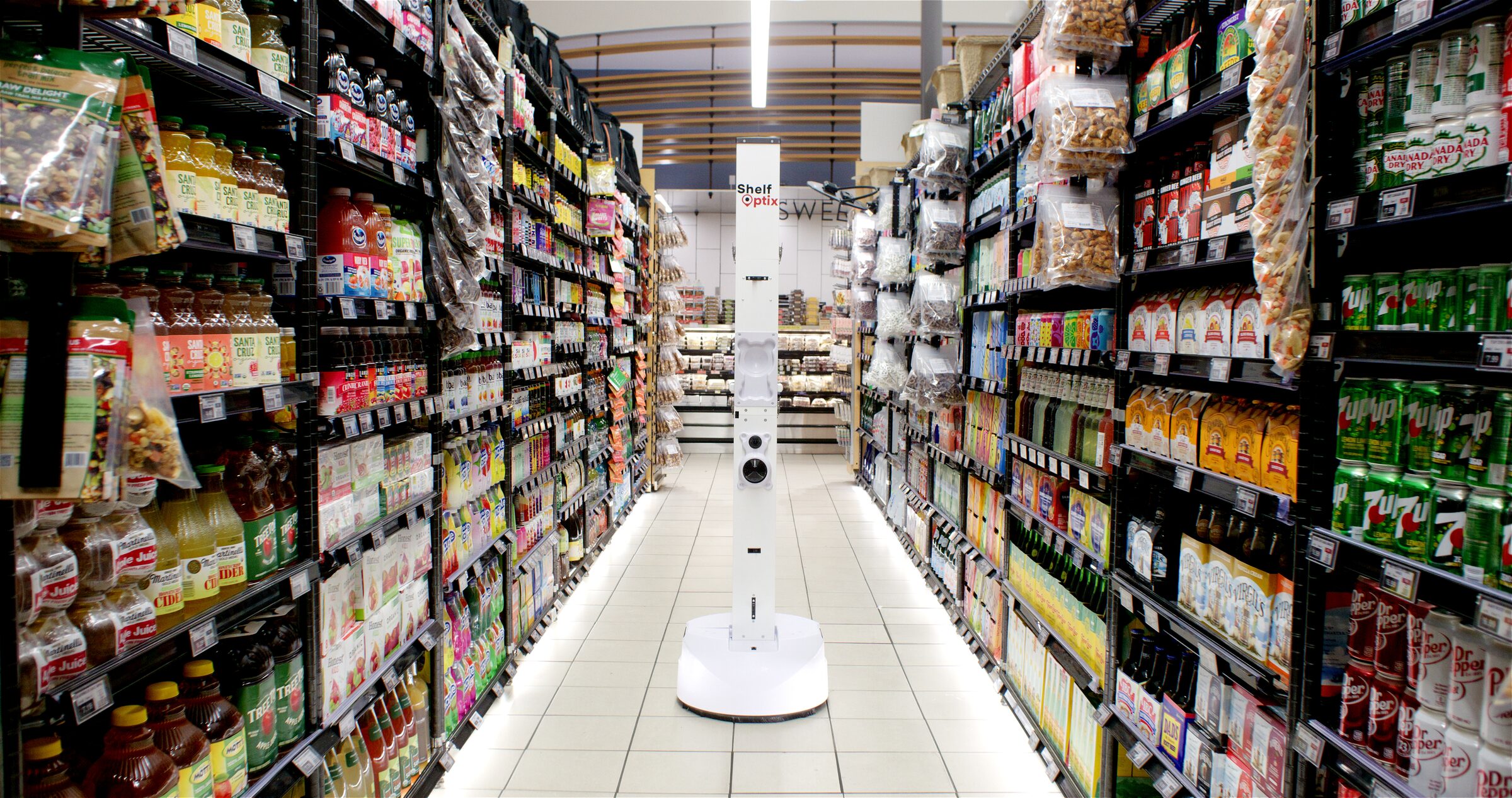
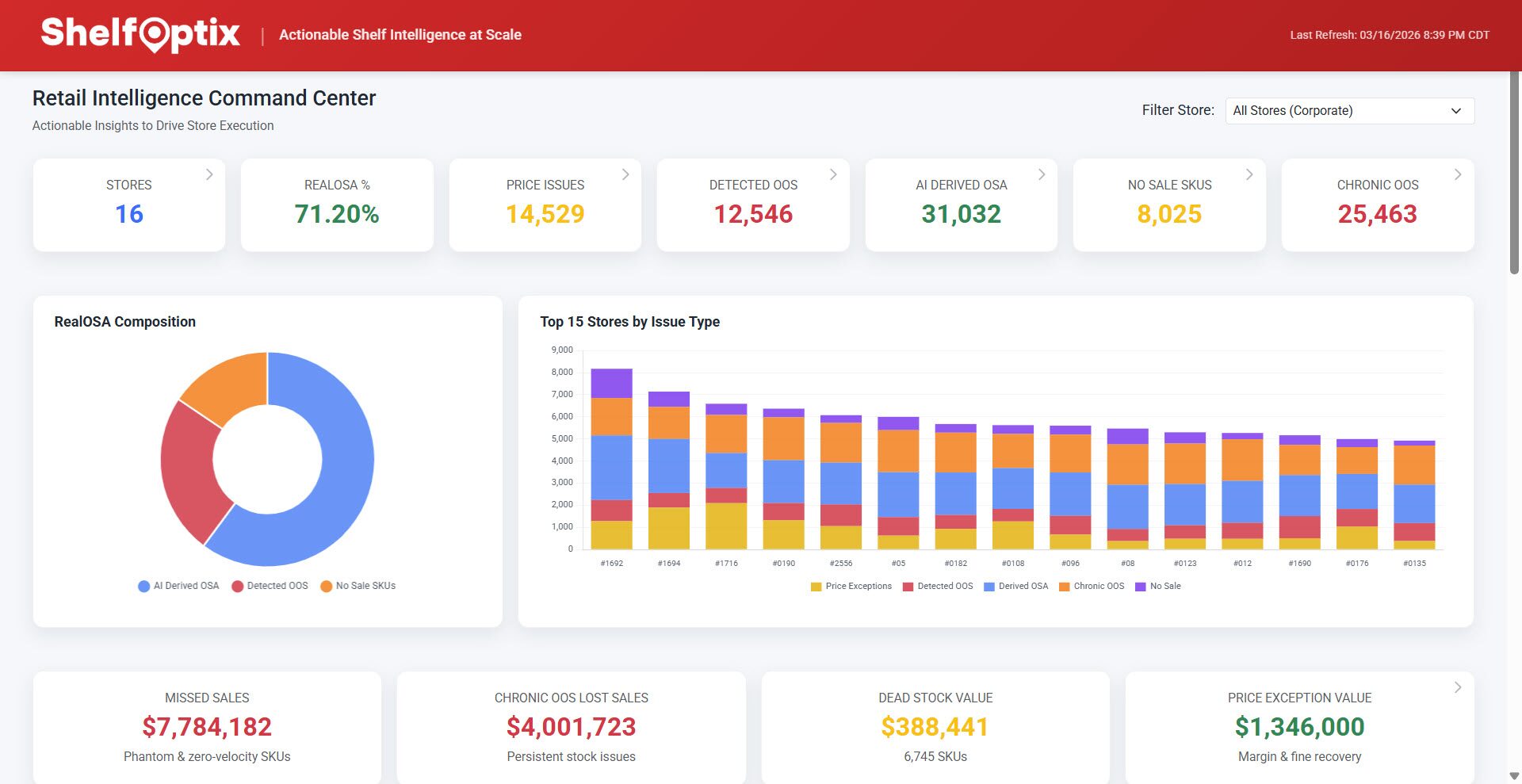
| Autonomous ground-truth scanning | Comprehensive whole-store digitization — precise SKU locations, price-tag accuracy, and physical out-of-stocks. | High-frequency (daily / 3× daily) | Moderate (managed service / opex) | Requires relatively clear aisles for navigation. Cannot physically move products to see what is hidden behind intentional plugs or front-facings. | Simbe, Pensa, ShelfOptix |
Methodology and vendor placement compiled from public product documentation and ECR Retail Loss research.
“Most retailers think their inventory accuracy is 95% or higher. Their shelves disagree. You cannot fix an operational execution gap that your enterprise systems refuse to see.”
Transitioning from reactive gap-filling to proactive, ground-truth inventory management requires a structured operational playbook that aligns technology with store-level execution.
Retail operations must decouple their understanding of inventory from the ERP’s mathematical assumptions. Establishing a baseline requires capturing the true physical state of the shelf at a high frequency — ideally daily. A system that physically confirms shelf conditions independently of ERP records is the only way to accurately quantify the delta between assumed inventory and actual on-shelf availability.
Inventory distortion rarely follows an even distribution. By overlaying ground-truth data against the perpetual inventory file, category managers can quickly identify Pareto patterns. Teams must isolate the specific SKUs and aisles that habitually show high system counts but zero physical presence. These are typically high-theft items, easily misplaced small-format goods, or products chronically prone to receiving errors.
Visibility without workflow integration creates alert fatigue. Data must route directly into exception-based workflows for store associates. Instead of conducting full-aisle manual counts, staff are directed only to specific locations where the physical shelf contradicts the system record.
Real-world deployments demonstrate the power of this focused approach. When retailers shift to exception-based counting, they have seen a 43% reduction in balance errors, a 27% reduction in total inventory discrepancies, and a 1.6% improvement in overall product availability — while significantly reducing labor burden on store teams. Similar autonomous-scanning deployments achieve 95%+ out-of-stock detection accuracy, redirecting up to 50 hours per week of manual labor back to high-value customer-service tasks.
Correcting a phantom inventory record immediately unfreezes the replenishment algorithm. Once the erroneous system count is zeroed out by a store associate, new purchase orders flow automatically and the shelf is restocked. Revenue-growth-management teams should track the resulting OSA percentage-point improvements and map them against category sales baselines. Resolving phantom stockouts routinely recovers meaningful revenue, as a 1% gain in OSA corresponds to a ~0.5% lift in total sales.
Phantom inventory occurs when a retailer’s system records a product as in-stock, but the physical item is missing from the shelf. This discrepancy is primarily caused by unrecorded theft, items left in the backroom, products misplaced in the wrong aisle, scanning errors at checkout, or inaccurate receiving logs at the loading dock.
It critically degrades OSA by freezing automated replenishment. Because the inventory management system believes the product is still available, it will not trigger a reorder. The shelf remains empty indefinitely, lowering total store availability metrics and causing immediate lost sales until a physical audit corrects the data.
Detection requires identifying the gap between system data and physical reality. Retailers accomplish this through daily manual cycle counts, predictive point-of-sale algorithms that flag unexpected drops in sales velocity, fixed ceiling cameras, or autonomous mobile robots that continuously scan the aisles to capture the physical ground truth.
In a regular out-of-stock, the digital inventory record accurately reflects that zero units remain, which prompts the system to automatically reorder the product. In a phantom out-of-stock, the system falsely reports that units are available on hand, which prevents reordering and leaves the shelf empty.
Phantom inventory represents roughly 8% of total retail inventory loss and causes up to 80% of all out-of-stock events. This translates to a massive financial drain, contributing significantly to the nearly $1 trillion in total out-of-stock sales losses experienced by global retailers annually.
Technologies that fix this issue focus on reconciling digital records with physical truths. Leading solutions include AI-driven predictive POS modeling, fixed computer vision systems, smart-shelf weight sensors, and managed shelf-intelligence platforms utilizing autonomous robots to digitize shelf conditions seamlessly.
Correcting phantom inventory requires moving beyond proxy data. By establishing an automated, high-frequency baseline of reality, retail and CPG leaders can bridge the execution gap, restore forecasting accuracy, and reclaim lost revenue. ShelfOptix delivers managed ground-truth visibility at scale — no capital investment, no store labor.
Thanks for reaching out. A member of the ShelfOptix™ team will be in touch with you right away.