The global artificial intelligence in retail market was valued at $5.5 billion in 2022 and is projected to grow to $55.53 billion by 2030. AI does not just free up staff for higher-level tasks — it significantly improves the shopping experience and operates around the clock. Here’s how retailers are using AI to gain a competitive edge.
Artificial intelligence tools are not new to the retail sector. While ChatGPT brought mainstream attention to AI in recent years, several forward-thinking retailers have been using AI to improve performance and customer experience for much longer. The global artificial intelligence in retail market was valued at $5.5 billion in 2022 and is projected to grow to $55.53 billion by 2030 — a trajectory that signals a fundamental shift in how retail operations work.
AI does not just free up staff for higher-level tasks. It significantly improves the shopping experience, maintains on-shelf availability around the clock, and gives retailers actionable intelligence they never had before. From computer vision in retail that monitors every shelf to retail automation that eliminates manual scheduling, retailers are starting to see the value of AI and implement appropriate solutions for more efficient business.
Here are the key ways artificial intelligence is already transforming retail operations — and how managed shelf intelligence platforms like ShelfOptix™ amplify these benefits.
AI significantly improves the customer experience across the entire shopping journey. At its core, retail AI vision systems and machine learning algorithms analyze shopper behavior to deliver accurate product suggestions based on past preferences, purchase history, and browsing patterns. The result is a shopping experience that feels curated rather than generic.
The applications extend well beyond recommendations. Virtual fitting rooms allow customers to visualize products before purchasing. AI-powered chatbots resolve problems quickly without wait times. For the self-sufficient shopper, cashier-less self-checkout technology is transforming how people pay — saving time and reducing friction at the most critical moment of the shopping journey.
Beyond these individual technologies, AI builds customer loyalty by keeping track of individual behavior patterns. When a retailer understands what a customer buys, when they buy it, and how they prefer to shop, every interaction becomes an opportunity to strengthen that relationship — making shopping more personalized and more enjoyable.
Using AI tools delivers cost-effectiveness on multiple fronts — and the data backs it up. According to a Gartner report, AI for price optimization alone can grow revenue from 1% to 5%. For a retailer doing $1 billion in annual revenue, that represents $10 million to $50 million in incremental growth from a single AI application.
The operational savings go deeper. Mundane human tasks like scheduling, tracking, and routine auditing can be automated using the right tools, freeing up staff time to focus on what matters most: improving customer experience and driving sales. Retail automation eliminates the repetitive work that drains productivity without adding value.
“Instead of spending more on mass marketing methods, retailers can deploy AI-driven targeted campaigns with better returns — reaching the right customer with the right offer at the right time.”
AI also allows retailers to intelligently allocate resources toward marketing and advertising. Instead of blanket spending on mass marketing methods, AI-powered analytics identify which customers are most likely to convert, which channels deliver the best return, and which promotions drive the most profitable behavior. The result is a marketing budget that works harder at every level.
Perhaps most importantly, AI helps retailers order and maintain the right inventory. Instead of being faced with over-ordering (which ties up capital and creates markdowns) or critically low supply (which means lost sales), AI-driven demand forecasting ensures you stock what you can sell — and nothing more.
The right AI tools allow retailers to competitively price their products while still protecting margins. This is not guesswork — it is algorithmic price optimization powered by real-time data from multiple sources.
Imagine a system that combines current demand signals, trending market data, actual product cost, historical purchase behavior, real-time stock availability, and potential new model arrivals to calculate the optimal price or promotion. That system does not just move inventory — it ensures profit on every transaction. This is what a well-implemented retail AI vision platform delivers.
Price compliance is another critical piece of this puzzle. Retailers running hundreds or thousands of stores need to verify that shelf tags match promotional commitments, trade agreements, and corporate pricing strategies. AI-powered shelf monitoring — the kind ShelfOptix™ delivers — catches price tag mismatches the moment a scan is completed, turning a manual audit problem into an automated intelligence signal.
At this point, AI is a must for categorization, inventory management, and supply chain efficiency. Retailers who ignore this reality will find themselves outpaced by competitors who use AI to forecast demand, optimize replenishment, and maintain on-shelf availability at a level that manual processes simply cannot match.
The right tools allow retailers to forecast inventory needs based on customer behavior, historical sales data, seasonal trends, and even external factors like weather and local events. These algorithms identify purchase patterns that humans would miss, enabling smarter decisions about what to stock, when to reorder, and how to run seasonal promotions that actually drive sell-through.
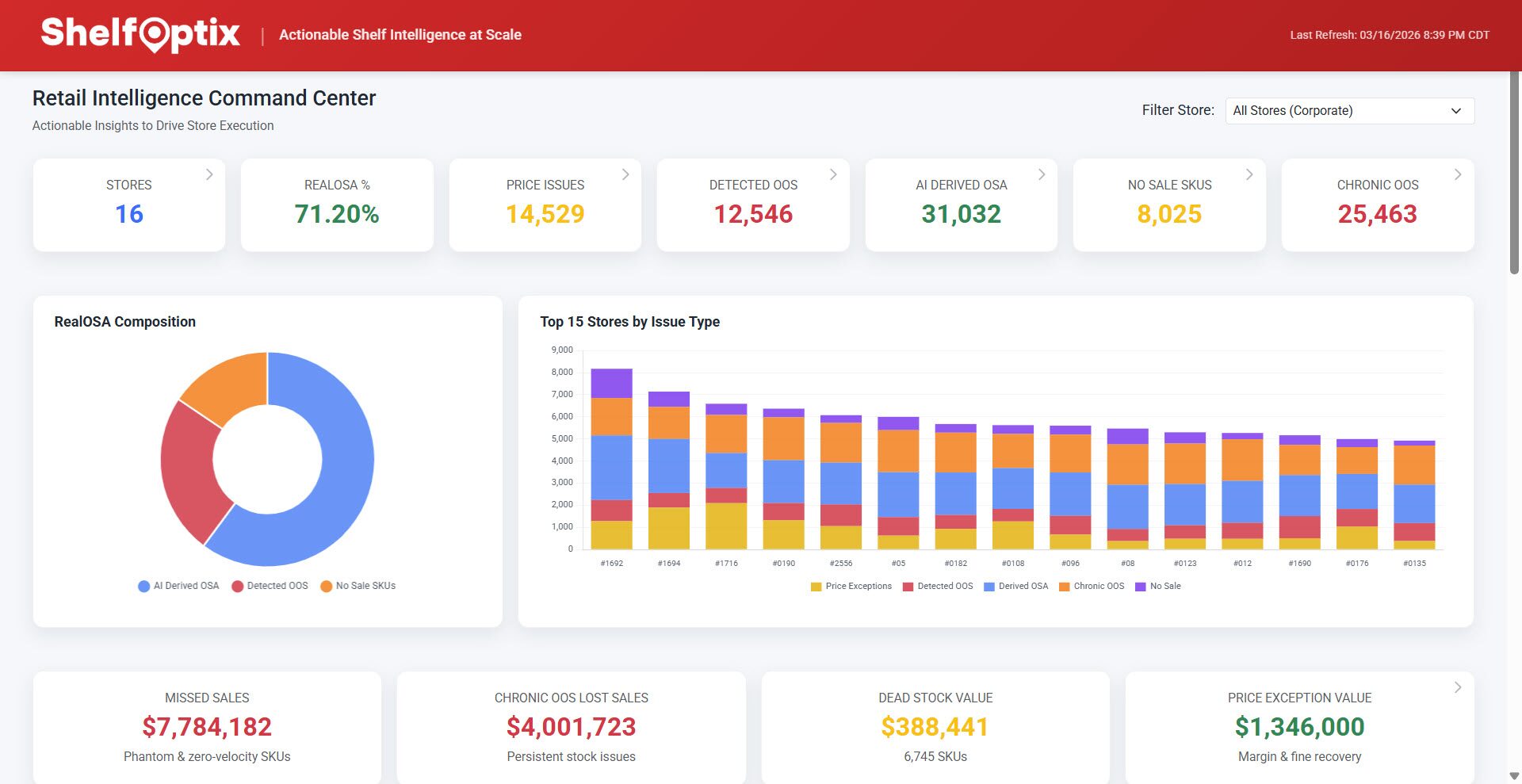
Inventory management powered by AI also closes the gap between what the system says and what the shelf shows. This is the difference between phantom inventory and ground-truth visibility. When your system says you have 10 units but the shelf is empty, you are not just losing sales — you are losing the ability to reorder, losing planogram compliance, and losing customer trust. AI-powered shelf intelligence eliminates that blind spot.
ShelfOptix™ is built for the retailers and CPG brands who understand that AI intelligence is only valuable when someone acts on it. As the first fully managed shelf intelligence service, ShelfOptix combines Brain Corp robotic scanning with Driveline Retail’s 15,000-person workforce to scan, analyze, and execute — delivering ground-truth shelf visibility at $0 robot CapEx.
Every AI capability discussed in this article — from inventory accuracy to price compliance to on-shelf availability — depends on one thing: knowing what is actually happening on the shelf. ShelfOptix provides that ground truth. And unlike solutions that stop at data delivery, ShelfOptix closes the loop. When a scan reveals an out-of-stock, a phantom inventory condition, or a planogram deviation, Driveline associates are already in the store to fix it.
That is the difference between shelf intelligence and shelf action — and it is the reason ShelfOptix exists.
AI in retail market size data sourced from published market research reports (2022–2030 projections). Price optimization revenue data sourced from Gartner. Out-of-stock detection market data from Verified Market Reports ($2.5B in 2024, projected $8.1B by 2033). Global inventory distortion data from IHL Services ($1.77 trillion annually).
ShelfOptix™ delivers the AI-powered shelf intelligence retailers and CPG brands need — plus the 15,000-person workforce to act on every insight. Zero robot CapEx. Zero operational burden.
Thanks for reaching out. A member of the ShelfOptix™ team will be in touch with you right away.